When enterprises start hitting the ceiling of single-agent AI systems — limited reasoning depth, brittle task delegation, poor context retention — the natural evolution is toward multi-agent architectures. At NSDBytes, we’ve been building production-grade multi-agent systems for our clients, and LangGraph has emerged as one of the most powerful frameworks for orchestrating these complex workflows. This walkthrough breaks down what multi-agent systems are, why LangGraph matters, and how your team can leverage this technology to build AI that actually scales.
What Is a Multi-Agent System (and Why Should You Care)?
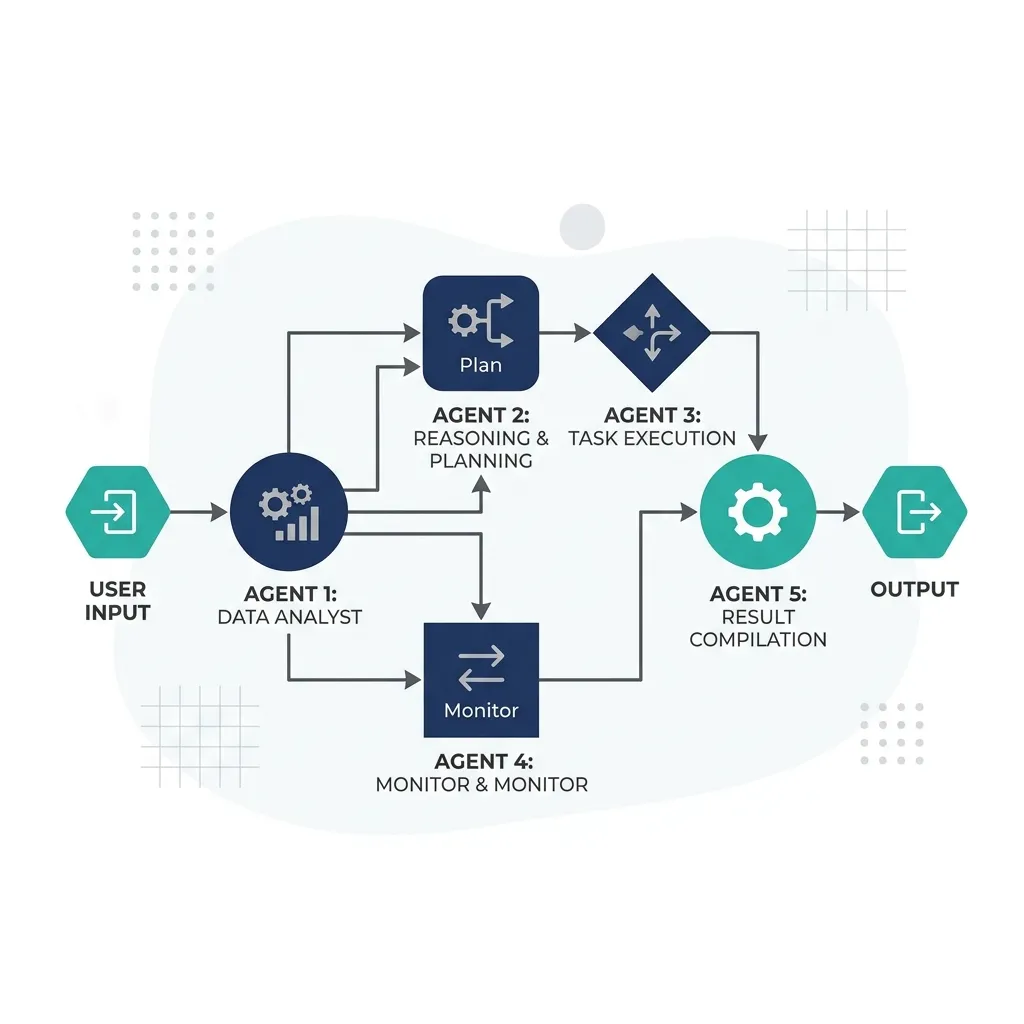
A single AI agent is like a talented employee working alone — capable, but limited by bandwidth and scope. A multi-agent system is the equivalent of a coordinated team, where specialized agents handle distinct tasks, pass information between each other, and arrive at outcomes no single agent could achieve alone.
For business leaders, this translates directly into:
- Higher accuracy — specialized agents outperform generalist ones in domain-specific tasks
- Better scalability — parallel processing across agents reduces bottlenecks
- Improved reliability — if one agent fails or halts, the system can reroute
- Modular upgrades — swap or improve individual agents without rebuilding the entire pipeline
Industries like financial services, legal tech, healthcare, and e-commerce are already deploying these systems to automate research, compliance monitoring, customer support escalation, and complex document analysis.
Why LangGraph? The Architecture Advantage
Before LangGraph, building multi-agent systems meant stitching together brittle chains with LangChain or hand-rolling custom orchestration logic. LangGraph changes the game by introducing graph-based state management — a fundamentally more powerful way to model agent interactions.
The Core Concept: Stateful Graphs
LangGraph represents your AI workflow as a directed graph where:
- Nodes represent individual agents, tools, or processing steps
- Edges define how information and control flow between nodes
- State is a shared object that persists and evolves as it moves through the graph
This means your agents aren’t just passing messages — they’re operating on a shared, structured memory that the entire system can read from and write to. For CTOs evaluating AI infrastructure, this matters enormously: it means your system can handle long-running workflows, maintain context across dozens of steps, and support conditional branching based on real-time outcomes.
Key LangGraph Features That Drive Real Value
- Cycles and loops — Unlike linear chains, LangGraph supports circular flows, allowing agents to retry, reflect, or seek clarification before proceeding
- Human-in-the-loop checkpoints — Critical decision points can pause for human approval before continuing
- Persistence layer — Built-in support for checkpointing means workflows survive failures and can resume mid-execution
- Streaming support — Real-time token and event streaming for responsive user interfaces
A Developer Walkthrough: Building a Multi-Agent Research System
At NSDBytes, we recently built a multi-agent research and summarization system for a client in the financial services space. Here’s a simplified breakdown of how we structured it using LangGraph.
Step 1: Define the Shared State
The first step is defining what information all agents will share. In Python, this looks like a typed dictionary:
from typing import TypedDict, List

class ResearchState(TypedDict):
    query: str
    search_results: List[str]
    analysis: str
    final_report: str
    requires_human_review: bool
Every agent reads from and writes to this state object, ensuring seamless handoffs between nodes.
Step 2: Build Specialized Agent Nodes
Our team defined three core agents:
- Research Agent — Queries external APIs and web sources to gather raw data
- Analysis Agent — Processes the raw data, identifies patterns, flags anomalies
- Report Agent — Synthesizes findings into a structured, human-readable report
Each agent is a Python function that receives the current state and returns updated state fields. This clean separation of concerns is exactly what makes multi-agent systems maintainable at scale.
Step 3: Wire the Graph
from langgraph.graph import StateGraph, END

workflow = StateGraph(ResearchState)

workflow.add_node("research", research_agent)
workflow.add_node("analysis", analysis_agent)
workflow.add_node("report", report_agent)

workflow.set_entry_point("research")
workflow.add_edge("research", "analysis")
workflow.add_conditional_edges(
    "analysis",
    route_based_on_confidence,
    {
        "high_confidence": "report",
        "low_confidence": "research"  # Loop back for more data
    }
)
workflow.add_edge("report", END)
Notice the conditional edge — if the analysis agent isn’t confident in its findings, it loops the research agent back for additional data gathering. This kind of dynamic routing is nearly impossible to implement cleanly without LangGraph’s graph paradigm.
Step 4: Add Human-in-the-Loop Checkpoints
For our financial services client, certain analysis outputs required compliance officer review before a report could be finalized. LangGraph’s interrupt mechanism made this straightforward:
workflow.add_node("human_review", interrupt_for_review)
workflow.add_conditional_edges(
    "report",
    check_review_required,
    {
        "needs_review": "human_review",
        "approved": END
    }
)
The workflow pauses, notifies the relevant stakeholder via an integrated notification system, and resumes once approval is received — all without losing state or context.
What This Looks Like in Production
Our team’s production deployment of this system included several additional layers that business leaders should be aware of when evaluating feasibility:
- Observability — LangSmith integration for full trace logging, latency monitoring, and error diagnosis across every agent call
- Retry logic — Exponential backoff on API failures with graceful degradation
- Cost controls — Token budget enforcement at the agent level to prevent runaway LLM spend
- Security boundaries — Agents operate with scoped permissions; no agent has access to data or tools beyond its designated role
The result was a system that reduced the client’s research and reporting cycle from 3 days to under 4 hours, with a measurable reduction in analyst error rates.
When Should Your Business Invest in Multi-Agent Systems?
Multi-agent architecture isn’t the right solution for every problem. At NSDBytes, we advise our clients to consider this approach when:
- Workflows involve multiple distinct domains requiring specialized reasoning
- Tasks are too long or complex for a single context window
- Reliability and auditability are non-negotiable requirements
- Human oversight needs to be embedded at specific checkpoints
- Parallel processing could meaningfully reduce time-to-output
If your current AI implementation feels like it’s hitting a wall — producing shallow outputs, struggling with complex tasks, or breaking under real-world conditions — multi-agent architecture is almost certainly the upgrade path.
The NSDBytes Approach to Multi-Agent Development
Building effective multi-agent systems requires more than technical proficiency. Our team combines deep LangGraph expertise with a rigorous systems design process: we map your existing workflows, identify where AI can create the most leverage, design agent roles with clear responsibilities, and build with observability and governance baked in from day one.
We don’t deliver AI demos. We deliver production systems that work — reliably, securely, and at scale.
Ready to Explore What Multi-Agent AI Can Do for Your Business?
Whether you’re in the early stages of evaluating AI investment or looking to upgrade a system that’s already deployed, our team at NSDBytes is ready to help you design the right architecture for your specific needs. The gap between businesses using single-agent AI and those running coordinated multi-agent systems is widening fast — and it’s a competitive gap that compounds over time.
Let’s build something that gives you a lasting edge.

Written by the NSDBytes Team
We are passionate about software development, AI integration, and helping businesses achieve operational excellence through modern technology.